
Explore Moray Speyside’s
Malt Whisky Trail
The world famous Malt Whisky Trail:-
Wherever you are in Moray, exploring the beautiful Moray Coast, enjoying the miles of green countryside or the dramatic mountains, you will never be far from a Malt Scotch Distillery, whisky is a way of life for our community, it has been part of our cultural heritage for over 500 years.
Explore Speyside’s Malt Whisky Trail, enjoy a warm welcome, appreciate the history, learn about and taste some great whiskies and treat yourself to some of the best food and drink that Scotland has to offer.
On your travels you will view a variety of stunningly beautiful landscapes which will help you appreciate how a governmental change over 200 years ago contributed to Moray Speyside becoming the whisky capital of the world.
Moray Speyside has an abundance of natural resources with luscious green fertile glens providing the finest barley, moors providing peat and a bountiful supply of soft water.
The distillers here acquired their expertise over centuries of fine tuning, honing to perfection their use of the natural resources to produce the most popular whiskies in the world.
If you are interested in reading more about the history of Scotch whisky making, especially in the Speyside area, click here, otherwise scroll on……
The story behind this area dominating the whisky market is a fascinating one, the Scotch Whisky timeline starts with the earliest documented record being an entry in the Exchequer Rolls of Scotland dated 1494, stating “eight bolls of malt to Friar John Cor wherewith to make aqua vitae.” Aqua vitae being latin for “water of life” which in turn is “Uisge Beatha”, (pronounced Ooshkih beh-ha), in gaelic, which was then anglicised to “whisky”.
In 1644 the first official taxes were imposed on Scotch Whisky, in 1707 following the Act of Union the Parliaments of England and Scotland united resulting in increased taxes. In 1757 a massive crop failure forced the British Government to prohibit the sale of distilled spirits for 3 years, the use of a private still for household consumption however was not prohibited. The consequences were inevitable, it was estimated that by the 1760’s, private distillers were producing around 500,000 gallons a year, meantime the legal distilleries were producing around a tenth of this! In 1781 distilling for private consumption was banned.
The government tried to control the legitimate distilleries and the Excise act of 1788 enforced a minimum “batch” volume to be processed within the pot still of 100 gallons (450 litres), this act only applied to the Lowland distilleries as at this time a different tax regime existed between Lowland and Highland areas.
The legitimate distilleries also had to pay a high rate of tax which was imposed on the malted grain so in order to cut costs unmalted raw grain and other inferior products were used. For the Lowland distilleries the use of inferior ingredients combined with being forced to use the larger stills resulted in a very poor quality whisky.
The Highland distillers were to be taxed on the whisky volume produced and allowed to use smaller stills, however the whisky produced by the few legitimate Highland distilleries could only be sold in the Highlands due to the differing tax regimes.
Meanwhile the operators of the illicit stills continuously improved their product using a high level of malt or exclusively malted barley in a small still with lots of copper contact producing a much more smooth and flavourful whisky.
Such was the difference in quality between the whiskies, almost everyone imbibed upon the superior illicit whisky, Lords and Lairds, members of Parliament, Judges, Lawyers, ministers of the gospel and even His Majesty George IV when he visited Edinburgh in 1822 asked for a whisky that had been produced in Glen Livet.
More than half of the whisky consumed in Scotland was being enjoyed without the taxman taking his cut despite it being more expensive than the whisky produced by the licensed whisky distilleries.
The authorities had been slow to act and lost control of the situation, by the 1820’s as many as fourteen thousand illicit stills were being confiscated each year across Scotland.
In the vast sparsely populated regions in the North and the Islands there were huge numbers of illicit distillers, there was said to be some 200 stills operating in Glen Livet alone.
You will see as you drive through the area the vast number of suitable locations next to water among the glens and crags and how easy it would be to set up a still. If you are visiting during the winter then you may see the extreme weather conditions this area can be exposed to. It would be very difficult for the Excise officers or “Gaugers” as they were known, (part of their job being to gauge how much malt or wash was being used by the legal distillers), to travel across Speyside trying to catch the illegal distillers in action. For this reason, much of the illegal distilling was done during the winter months, the barley would have been harvested and the water sources at their coolest.
Most people in the communities were aware of the illicit distilling and would happily turn a blind eye to their activities, even the usually honest members of the clergy were known to hide scotch under the pulpit. It is said that a horse drawn hearse with a coffin full of whisky would be used to transport the whisky and if passing the Excise officers the locals would take off their hats as a sign of respect, the officers had no choice, the whisky was allowed on its way!
This illicit trade diminished shortly after the Duke of Gordon, Speyside’s primary landowner proposed in the House of Lords that the government should reform the whisky taxes, the 1823 Excise Act was then passed sanctioning the distilling of whisky for a licence fee and a set payment per gallon of proof spirit reducing the duty on Scottish whisky by more than 50 percent.
This incentivised many of the illicit distillers to legitimise themselves, (most notably George Smith who founded Glenlivet), or seek work for the many newly formed distilleries and grow their business.
Speyside distilleries Balmenach, Cardhu, Glenlivet, Mortlach, Strathisla (1786) & The Macallan all obtained their licence at this time.
(Even though the illicit trade faded away following the 1823 Excise Act, isolated cases continued up to as recently as 1934 when a prosecution took place after a 12 gallon still was discovered in a cellar below the Gordon Arms Hotel in Keith!).
In 1861 the Strathspey Railway Company built a line between Keith and the Boat of Garden with stops at Aberlour, Craigellachie, Knockando and Ballindalloch, thereby improving transport links to the south. New distilleries located themselves around the line opening Speyside up to the blending market.
The number of distilleries in Speyside has grown substantially over the past 150 years making Speyside the Heartland of Scotch Whisky, with more than 50 active distilleries, Speyside is the most densely populated whisky region in the world.
Although blended Scotch Whisky dominates the market by volume, Single malt Scotch Whisky’s popularity is on an uphill trajectory, exports of single malt broke through the £2 billion barrier for the first time in 2023.
This trend for premium Scotch is dominated by Glenlivet, Glenfiddich and Macallan who between them make up one third of the entire single malt market.
You can visit all three and many others on the Malt Whisky Trail shown below. The official Malt Whisky Trail is a partnership of distilleries namely, Benromach, Glen Grant, Glen Moray, Glenfiddich, The Glenlivet and Strathisla along with The Speyside Cooperage. This list originally included Dallas Dhu, a whisky museum in Forres, unfortunately this is currently closed, but is scheduled to reopen soon as a working distillery / visitor centre.
We have added an additional four distilleries to the list that we would recommend, Benriach, The Macallan, Cardhu and Balvenie. We have also added Gordon & MacPhail, the Dram Tram and Byres Farm as venues / activities worthy of your attention!

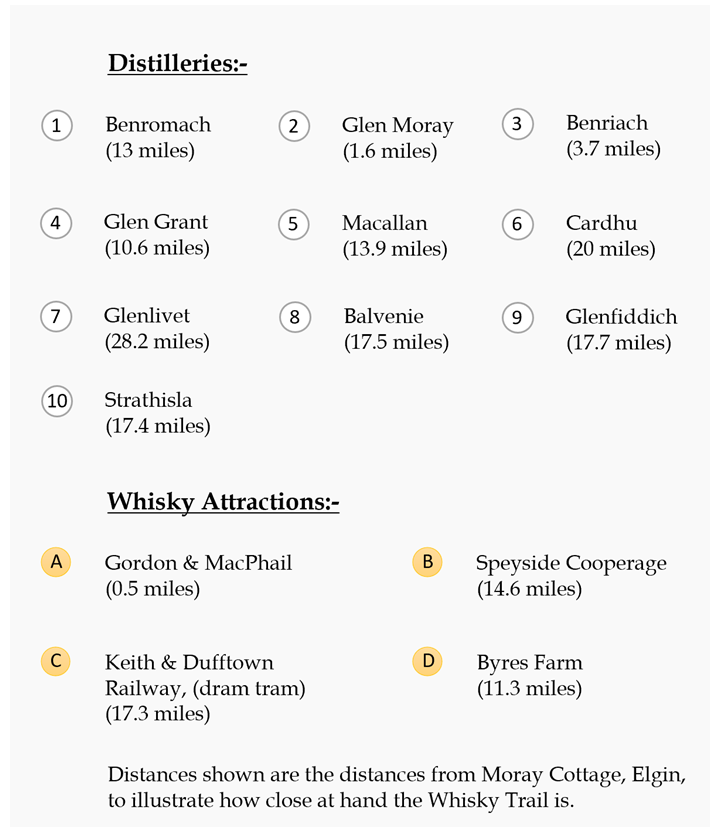
Distilleries:-
The Strathspey area, “strath” meaning “near”, so “near the Spey” covers many distilleries and Speyside whiskies are known for their soft, gentle and fruity style which can be either light or rich depending upon the distiller.
Lighter whiskies express notes of apples, pears, honey, vanilla and spice having been predominantly matured in ex-bourbon casks, fine examples include Glenlivet, Glenfiddich and Glen Moray.
The richer whiskies are more dark and complex expressing notes of toffee, caramel, raisins / sultanas and candied orange peel having spent a large percentage of maturation in ex-sherry casks, fine examples include Aberlour, Glenfarclas and Macallan.
Historically, Strathspey distilleries would have burnt peat or a mixture of peat and coke to dry their malted barley but since the 1960’s the use of peat was phased out in the search for a light, floral and fruity whisky. Currently a number of distilleries are revisiting the use of peat, peat from the Strathspey area is more plant based, (predominantly heather), leading to rich, earthy notes.

1) Benromach Distillery
Acquired by Gordon & MacPhail in 1993 and restored to produce whisky using traditional / manual methods. Using a lightly peated malt, (as traditionally used in Speyside), in smaller batch production a core range of subtly smoky single malts are offered.
Various tours and tastings are available by arrangement around the distillery or alternatively around the Red Door Gin distillery next door, maximum of 8 people.
Benromach Distillery, Invererne Road, Forres, IV36 3EB
2) Glen Moray Distillery
Located on the banks of the River Lossie, Glen Moray has their core range and heritage range offerings matured in ex bourbon american oak casks from Kentucky. They also have a history of experimenting with different cask types resulting in port, sherry, chardonnay, cabernet and rhum agricole finishes as well as various peated single malts.
Various tours and tastings are available, a visit to Glen Moray House, (an ex-excise mans house), is recommended. The visitor centre has a coffee shop serving breakfasts and light lunches and a gift shop.
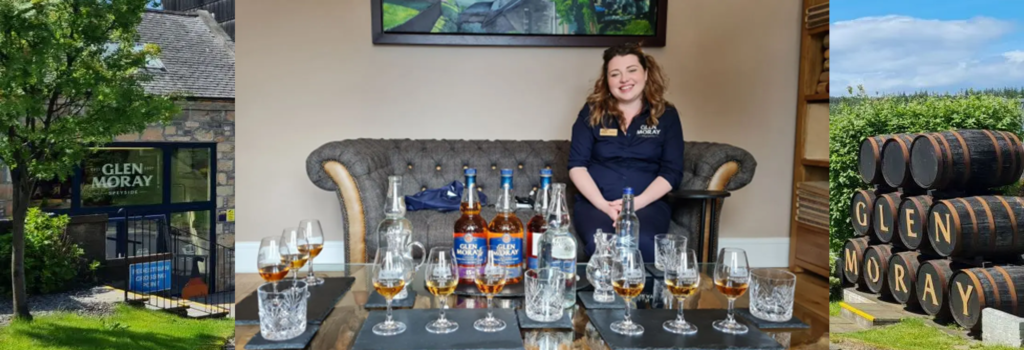
Glen Moray Distillery, Bruceland Road, Elgin, IV31 1YE
3) Benriach Distillery
Benriach was founded in 1898 on the site of the old Riach Farm. The Benriach Distillery draws its water from a mineral rich aquifer deep beneath its grounds. Benriach released their first 10 year old single malt in 1994 and since then have explored various finishes for their three styles of whisky, classic – (unpeated), peated and triple distilled. As well as virgin oak and bourbon casks the core range expressions include the use of rum, madeira, sherry, port, red wine and marsala casks.
A number of tours are offered as well as evening experiences and there is a distillery shop.
Benriach Distillery, Longmorn, Near Elgin, IV30 8SJ
4) Glen Grant Distillery
Glen Grant distillery was founded in 1840 and is unique in that it is the only Scotch Whisky distillery that is named after its owners. It is a light and fruity whisky having been matured in bourbon or sherry casks.
Tours are available and it is worth exploring the Victorian Gardens and finding Major Grants Dram Pavilion and Dram Hut with its whisky safe.
Glen Grant Distillery, Elgin Road, Rothes, AB38 7BS
5) The Macallan
An architecturally highly acclaimed Distillery & Visitor Experience was built in 2018 housing 12 wash stills and 24 spirit stills.
The Macallan is very much focused on the premium market, releasing collaboration collections and collections targeted at global travel retail.
All visits are by appointment only.
Macallan Distillery, Easter Elchies, Craigellachie, AB38 9RX
6) Cardhu Distillery
Cardhu is the first distillery to be officially pioneered by a woman, founded by Helen Cumming in 1811 as an illicit distillery and licensed in 1824. Cardhu is the Speyside Home of Johnnie Walker, Cardhu meaning ‘black rock’ in gaelic.
Cardhu Single Malt Whisky is very successful however most of the distillery’s production is used for the blends of Johnnie Walker.
A number of tours are available or you can visit the bar or The Tasting Kitchen.

Cardhu Distillery, Knockando, Aberlour, AB38 7RY

7) Glenlivet Distillery
In 1824, founder George Smith was the first to purchase a licence and built the first legal distillery in the Livet Valley. It is said that he was given a pair of pistols from the Laird of Aberlour to protect himself from his neighbours wrath!
A number of tours and tastings are available and there is a bar and a shop.
Glenlivit Distillery, Ballindalloch, AB37 9DB
maltwhiskydistilleries.com/theglenlivit/
8) Balvenie
Balvenie distillery was founded in 1892 by William Grant, a short walk from his first distillery Glenfiddich. Balvenie stays true to their five rare crafts to make whisky as they always have, using home grown barley, a working malting floor, copper stills, an on-site cooperage and a Malt Master.
The Balvenie brings together crisp orchard fruit with honeyed notes. Equally at home maturing in bourbon and sherry casks.
Tours must be prebooked.
Balvenie Distillery, Station Road, Dufftown, AB55 4BB
9) Glenfiddich
Glenfiddich derives from the gaelic term ‘Gleann Fhiodhaich’ meaning “valley of the deer”, it was established by William Grant in 1876 and is one of the few single malt distilleries to remain family owned. It has 16 wash stills and 27 spirit stills.
There are a number of tours available, the Malt Barn Coffee shop & Bar.
Glenfiddich Distillery, Castle Road, Dufftown, AB55 4DH
10) Strathisla
Strathisla Distillery is the oldest continuously working distillery in the Highlands dating back to 1786. It is the spiritual home of Chivas, since the Chivas brothers purchased the distillery for £71,000 in the 1950’s. Earlier records show a request from Queen Victoria for a case of whisky and a quiet donkey for trips around the park!
Discover the world of Chivas Regal blends and the Strathisla single malts. A number of tours and tastings are available and they also offer a Chivas Blending Workshop where you can create your own Blended Scotch Whisky.

Strathisla Distillery, Seafield Avenue, Keith, AB55 5BS
maltwhiskydistilleries.com/strathisla/
Whisky related Attractions:-
A) Gordon & MacPhail
Gordon & MacPhail established themselves as a grocery business in 1898 and sought to expand their offerings of single malt Scotch whiskies. They evolved by purchasing and maturing whiskies from local distilleries and created house blends for their customers. In the mid 1950’s they showcased single malts at a time when most whiskies were used for blending. They bottled the four oldest whiskys ever released, including the 1939 75 year old Mortlach and a 71 year old Macallan under their Speymalt range. Their production of independent bottlings is well known among whisky enthusiasts and they now own the Benromach Distillery and the Cairn Distillery.
Temporary address: Unit 1, 121 High Street, Elgin, IV30 1EA
Closed for refurbishment: 58-60 South Street, Elgin, IV30 1JY
B) Speyside Cooperage
Since 1947, the family owned Speyside Cooperage has produced the finest casks from the best American Oak, (in 2008 the cooperage was sold to French firm Tonnellerie Francois Freres). See for yourself the ancient art of coopering, experience the sight, sounds and smells and watch in real time as the coopers shave and shape casks with an expertise that takes years to master. Learn about the relationship between the cask and its contents and what influences the maturation process.
Finish in the Toasting Room for a dram of Speyside Cooperages own 10 year old malt whisky. Booking your tour is essential, a gift shop is onsite.
Speyside Cooperage, Dufftown Road, Craigellachie, AB38 9RS
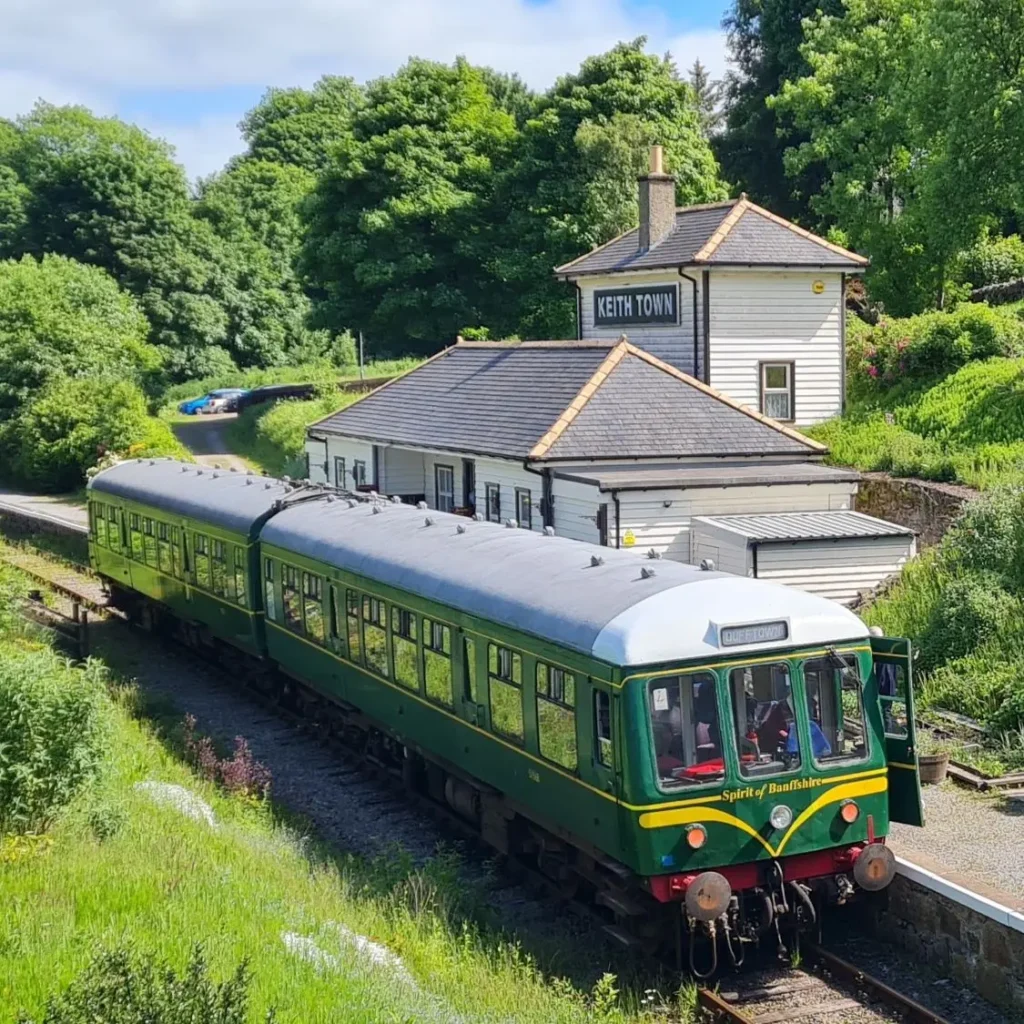
C) Keith & Dufftown Railway

“The Whisky Line” is a heritage railway run by volunteers traversing the 11 miles between Keith & Dufftown via Drummuir and Auchindachy. At Dufftown there is a waiting room and a cafe, while at Keith station there is a shop. Why not plan your distillery visit(s) incorporating a train trip, distilleries are within walking distance at both Keith & Dufftown and interconnecting buses and trains are available so no need to drive!
There are a number of special events including the infamous dram tram, check the website for standard timetables and special events.
Keith Station, Church Road, Keith, AB55 5BR
Dufftown Station, Station Road, Dufftown, AB55 4BA
D) Byres Farm
Byres farm grows malting barley which they sell to the Pernod Ricard Group who in turn produce The Glenlivet and Aberlour whisky. Tours with Farmer Bill are offered where he will show you the expertise required that goes into producing the barley before the start of the malting process. The farmer will show you the machinery and explain how the barley production fits into their farming system as well as the environmental and conservation impacts on the farm.
Tours must be pre-booked and last between 1 to 1.5 hours.
Byres Farm, Fochabers, Moray, IV32 7PH
